
Methyl-Guard Plus, from Thorne
It promotes general health and a longer healthspan.*
*These statements have not been evaluated by the Food and Drug Administration. This product is not intended to diagnose, treat, cure, or prevent any disease.
Photo: Nutrition, Food Safety & Health, “Fresh asparagus spears on plate,” via Wikimedia Commons, CC0

What It Is
A blend of B vitamins: folate, B12, B6, and B2, all in their active forms, plus trimethylglycine, a nutrient found in beets.
Dr. Bill favors active forms whenever possible, such as active folate instead of folic acid.
Thorne’s own description: “Methyl-Guard Plus provides superior methyl donors – trimethylglycine, 5-MTHF, and methylcobalamin – combined with bioactive vitamins B2 and B6 in a powerhouse formula for whole-body methylation support.*”
Photo: Judgefloro, “774Spinach leaves 05,” via Wikimedia Commons, CC0. Quote: thorne.com, Methyl-Guard Plus product page, read Nov 1, 2026

Why Take It
Food does not supply these vitamins in their active form.
This will improve your methylation status, which affects DNA expression and other critical functions in your body, including vascular health.*
Photo: Kuttykrishnan Photos, “Black eyed peas food,” via Wikimedia Commons, CC0

How to Take It
One capsule a day, which is precisely the best dose, at about $21 a month. Store in a cool, dry place.
Cost: $62 for 90 capsules at thorne.com, checked Nov 1, 2026; at one capsule a day, about $0.69 a day. Prices may change. Photo: AlixSaz, “Ordinary chickpeas in a ceramic bowl,” via Wikimedia Commons, CC BY‑SA 4.0

Our Recommendation
Recommended for everyone over fifty, when deficiency is very common.
In Dr. Bill’s words: “This is an excellent product for general physical wellness. I highly recommend it.”
Like many things that support your general wellness, you may not notice a change in your body, but you still will benefit.
Dr. William R. Schroeder, DO, MCDB
Safety
Any agent you use for wellness should be taken with full knowledge of the product.
For safety information, see Thorne’s website.
Notice
For educational purposes only. Your decision to take this agent should be based on this.
These statements have not been evaluated by the Food and Drug Administration. This product is not intended to diagnose, treat, cure, or prevent any disease.
To learn more, visit Thorne’s product page.
[Draft: opens My Wellness Regimen; Buy buttons become PWS affiliate links once approved]
Visit Thorne’s Product PageMethyl-Guard Plus is Thorne’s product name, written as Thorne writes it. Voice: Kokoro (Apache 2.0). Music: “Catfish Muse” by R. Carlos Nakai, from Inner Voices (Canyon Records). [License pending: not yet requested from Canyon Records; private draft only]
Take a Deep Dive: the Benefits and Risks
Not narrated. Every source was read Nov 1 to 2, 2026.
Risk and Benefit at a Glance (Leo’s draft ratings from the sources below; Dr. Bill sets the final ratings)
What studies in people show: moderate for raising folate and lowering homocysteine (a blood marker); limited for how people feel or fare. Long trials of similar B vitamins found no fewer heart events or fractures.
Safety: some cautions. At Dr. Bill’s recommended one capsule a day, the methylfolate is 1,000 mcg, at the NIH upper limit for folate from supplements, so count any other folate, such as a multivitamin. The B6 (15 mg) is under the U.S. limit of 100 mg and above Europe’s 2023 limit of 12 mg. The full 3 capsule label serving is 3 times the folate limit.
Drug interactions: some (methotrexate for cancer, seizure medicines; see Medicines below)
Shelf: General Health Recommendation (Dr. Bill’s placement, Nov 2, 2026): “Little interaction with your healthcare provider is usually needed for this item.”
What it is, in more detail
Methylfolate (L‑5‑MTHF) is a form of folate the body can use without first converting it. The NIH says: “Some dietary supplements also contain folate in the monoglutamyl form, 5-MTHF (also known as L-5-MTHF, 5-methyl-folate, L-methylfolate, and methylfolate).” For B12: “Methylcobalamin and 5-deoxyadenosylcobalamin are the metabolically active forms of vitamin B12.” For B6: “Pyridoxal 5’ phosphate (PLP) and pyridoxamine 5’ phosphate (PMP) are the active coenzyme forms of vitamin B6.” (NIH Office of Dietary Supplements fact sheets: Folate, Vitamin B12, Vitamin B6)
Why methylation matters, in the NIH’s words: “One of the most important folate-dependent reactions is the conversion of homocysteine to methionine in the synthesis of S-adenosyl-methionine, an important methyl donor.” Betaine (trimethylglycine) is a second methyl donor in the same cycle.
The methylfolate here is a branded salt. The label says: “This product uses Gnosis S.p.A.’s L-5-methyltetrahydrofolic acid, glucosamine salt (quatrefolic). Quatrefolic is a registered trademark of Gnosis S.p.A.” (NIH Dietary Supplement Label Database, record 291788) The only PubMed study found under that name was in rats (PMID 27008238).
Thorne also sells the original Methyl-Guard (3 capsules twice a day). In Thorne’s words, Plus gives “Robust methylation support in fewer capsules per day than Thorne’s original Methyl-Guard”.
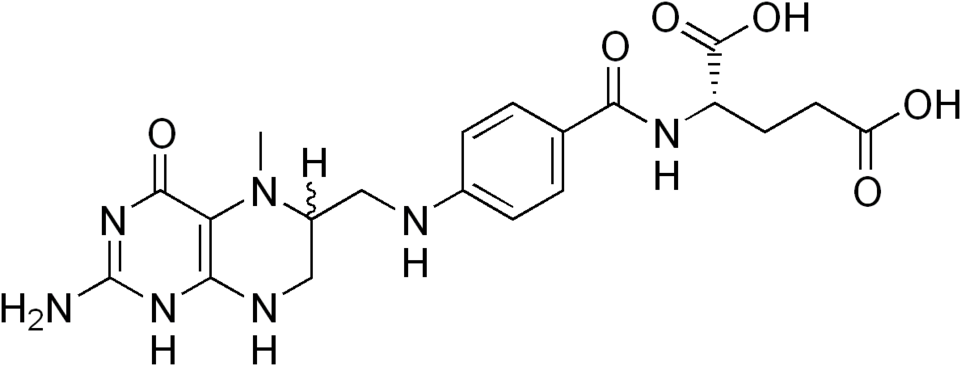
5‑Methyltetrahydrofolate structure: Edgar181, via Wikimedia Commons, public domain
What research in people shows, and does not show
No published trial of Methyl-Guard Plus itself was found (PubMed search, Nov 2, 2026). The studies below tested its ingredients.
- Methylfolate vs folic acid, 2003, Am J Clin Nutr (Venn et al., PMID 12600857): 167 healthy adults, 24 weeks, low doses. “Low-dose L-MTHF is at least as effective as is folic acid in reducing tHcy concentrations in healthy persons.” (tHcy is total homocysteine.) PubMed lists non U.S. government support; sponsor not named in the abstract.
- 2004 and 2006, Am J Clin Nutr (Lamers et al., PMIDs 14985224, 16825690): 144 healthy women, 24 weeks. Homocysteine fell about the same with methylfolate or folic acid; red blood cell folate rose more with 416 mcg methylfolate than with 400 mcg folic acid. Non U.S. government support; sponsor not named in the abstract.
- 2018, Int J Food Sci Nutr (Sicińska et al., PMID 28460586): 40 adults aged 50 to 65, 4 weeks: methylfolate lowered homocysteine 7.8%, folic acid 13.4%; the difference was not significant (p = .243).
- 2025 review of 11 trials in women, Medicine (Xie et al., PMID 41398893): active folate raised blood folate more and left less unmetabolized folic acid, but no difference in homocysteine, B12, or betaine; the authors call the studies limited in quality and short. No funding, no conflicts declared.
- The closest combination, 2024, Nutrients (Pokushalov et al., PMID 38892484): 54 adults aged 40 to 75 with high homocysteine and folate gene variants, 6 months, a daily 2 mg methylfolate, 100 mg P5P, and 1 mg methylcobalamin, versus placebo. Homocysteine fell 30% and LDL cholesterol 7.5% versus placebo. Funded by S.Lab (Soloways), which made the capsules; four authors work for Triangel Scientific. Leo did not find side effects reported in the paper. This is the longest methylfolate trial found: 6 months.
- Betaine. A 2013 pooled analysis of 5 trials (at least 4 g a day for 6 to 24 weeks) found homocysteine 1.23 micromol/L lower (McRae, PMID 23997720). A 2022 pooled analysis found doses under 4 g a day lowered homocysteine “without the lipid-augmenting effect observed with a higher dosage”; at 4 g or more, LDL rose about 10 mg/dL (Ashtary-Larky et al., PMID 33764214). A 2021 pooled analysis found total cholesterol rose at 4 g or more a day (Zawieja et al., PMID 31809615). This product gives 0.6 g per capsule, 1.8 g at the full 3 capsule serving.
- Not every result is positive: long trials of similar B vitamins. 2008, JAMA (Albert et al., PMID 18460663): 5,442 U.S. women at high heart risk took 2.5 mg folic acid, 50 mg B6, and 1 mg B12 daily for 7.3 years. Homocysteine fell 18.5%, but the pill “did not reduce a combined end point of total cardiovascular events.” The same trial found no effect on cancer (Zhang et al., PMID 18984888). Funded by the U.S. National Heart, Lung, and Blood Institute.
- B-PROOF (van Wijngaarden et al. 2014, PMID 25411293): 2,919 adults 65 and older, 400 mcg folic acid plus 500 mcg B12 for 2 years: no effect on osteoporotic fractures; more people in the vitamin group reported cancer (63 vs 42; HR 1.56), though “the study was not designed for assessing cancer outcomes.” Follow-up at 5 to 7 years: no effect on fractures or heart disease (Oliai Araghi et al. 2021, PMID 32800386). These used folic acid, not methylfolate.
- The NIH sums up: “Folic acid (and vitamin B12) supplements lower homocysteine levels. However, these supplements do not actually decrease the risk of cardiovascular disease, although they appear to provide protection from stroke.” And on energy: “vitamin B12 supplementation appears to have no beneficial effect on performance in the absence of a nutritional deficit.” (NIH ODS Folate and Vitamin B12 fact sheets)
Full safety information
How to take it (label only). “Take 1-3 capsules daily or as recommended by your health-care practitioner.” One serving a day, 1 to 3 capsules; the label’s serving size is 3 capsules. “Store tightly sealed in a cool, dry place.” The label does not say whether to take it with food or at what time of day. (thorne.com; NIH label record 291788)
PWS recommendation. Dr. Bill recommends one capsule a day. One bottle (90 capsules, $62 at thorne.com, checked Nov 1, 2026) lasts 90 days: about $0.69 a day, about $21 a month. Prices may change.
Upper limits (adults, NIH).
| Nutrient | 1 capsule (advised) | 3 capsules | NIH upper limit |
|---|---|---|---|
| Folate (methylfolate) | 1,000 mcg | 3,000 mcg | 1,000 mcg (supplements and fortified foods). At the limit with 1; over at 3. Count other folate. |
| Vitamin B6 (P5P) | 15 mg | 45 mg | 100 mg (U.S.). Europe (EFSA, 2023): 12 mg; 1 capsule (15 mg) is above it. |
| Vitamin B12 | 1 mg | 3 mg | None set: “because of its low potential for toxicity” |
| Vitamin B2 | 30 mg | 90 mg | None set; NIH urges caution with excessive amounts |
| Betaine | 0.6 g | 1.8 g | None set; cholesterol rose at 4 g or more a day in trials |
Folate and vitamin B12. The NIH set its folate limit “for the synthetic forms of folate available in dietary supplements and fortified foods” because of the B12 link: “Some experts have therefore been concerned that high intakes of folate supplements might mask vitamin B12 deficiency until its neurological consequences become irreversible. Questions about this possibility still remain, but the focus of concern has shifted to the potential for large amounts of folate to precipitate or exacerbate the anemia and cognitive symptoms associated with vitamin B12 deficiency.” This product also contains B12. Researchers have suggested methylfolate is “unlikely to mask vitamin B-12 deficiency symptoms” (Lamers 2004), but the NIH limit does not make an exception for it. “The ULs do not apply to individuals taking high doses of supplemental folate under medical supervision.”
Vitamin B6 and nerves. The NIH: chronic administration of “1–6 g oral pyridoxine per day for 12–40 months can cause severe and progressive sensory neuropathy.” It adds that “several reports show sensory neuropathy occurring at doses lower than 500 mg/day,” and that in 2023 the European Food Safety Authority “set an upper limit for vitamin B6 of 12 mg/day for all adults.” A 2023 systematic review: “Current scientific evidence supports a neurotoxic role of B6 at high levels” (Muhamad et al., PMID 37447150). Most cases involve pyridoxine; a 2021 review proposed a mechanism specific to pyridoxine (Hadtstein and Vrolijk, PMID 33912895). This product uses P5P; whether P5P carries the same risk has not been settled in people. The NIH adds that “the symptoms usually stop if the patient discontinues the pyridoxine supplements as soon as the neurologic symptoms appear.”
Adding a multivitamin (stacking). B6 and folate add up across products. With Thorne Basic Nutrients 2/Day (20 mg B6 and 400 mcg methylfolate per 2 capsule serving; NIH label record 323076), one capsule of Methyl-Guard Plus makes about 35 mg B6 and 1,400 mcg methylfolate a day. That is over the NIH folate upper limit of 1,000 mcg. The NIH adds: “The ULs do not apply to individuals taking high doses of supplemental folate under medical supervision.” With Life Extension One-Per-Day (75 mg B6; NIH label record 328606), one capsule brings B6 to about 90 mg, just under the U.S. limit of 100 mg; at 3 capsules it reaches about 120 mg, over the U.S. limit. That multivitamin’s folate (680 mcg DFE, as methylfolate) also adds to the folate total. Count every product you take.
Medicines. Thorne’s own warning: “5-methyltetrahydrofolate (5-MTHF) supplementation is not recommended concurrently with methotrexate cancer therapy, as it can interfere with methotrexate’s anti-neoplastic activity; however, 5-MTHF has not been shown to interfere with the anti-inflammatory activity of methotrexate.” The NIH: seizure medicines such as phenytoin, carbamazepine, and valproate “can reduce serum folate levels,” and “folate supplements might reduce serum levels of these medications, so patients taking antiepileptic drugs should check with their health care provider before taking folate supplements.” Sulfasalazine lowers folate absorption. For B6, the NIH lists cycloserine, seizure medicines, and theophylline. Metformin and acid reducers can lower B12 levels. Leo did not check a full drug interaction database (levodopa was not checked).
Pregnancy and breastfeeding. The label: “If pregnant, consult your health-care practitioner before using this product.” The NIH folate limit is the same 1,000 mcg in pregnancy and lactation, and the NIH notes that “intakes of 1,000 mcg per day or more of folic acid from supplements during the periconception period have been associated with lower scores on several tests of cognitive development in children at age 4–5 years” (a study of folic acid, not methylfolate).
The label itself says: “This product is contraindicated in an individual with a history of hypersensitivity to any of its ingredients.” Gluten free, dairy free, soy free (Thorne).
Testing. No regulator or guideline that Leo found requires routine tests before or during use. Discuss with your provider whether any tests are right for you.
Working with your provider. Bring this guide to your doctor or healthcare provider. Some providers know supplements well, and some do not; the practitioner summary gives them the studies and safety data to review with you. Decide together, with the testing your provider recommends.
Plain-Language Guide (PDF) Practitioner Summary (PDF)Videos from Thorne
Thorne has two official YouTube videos about this product (“Methyl-Guard Plus” and its described audio version, found Nov 1, 2026). Their narration makes health claims, so under PWS rules they are not shown here.